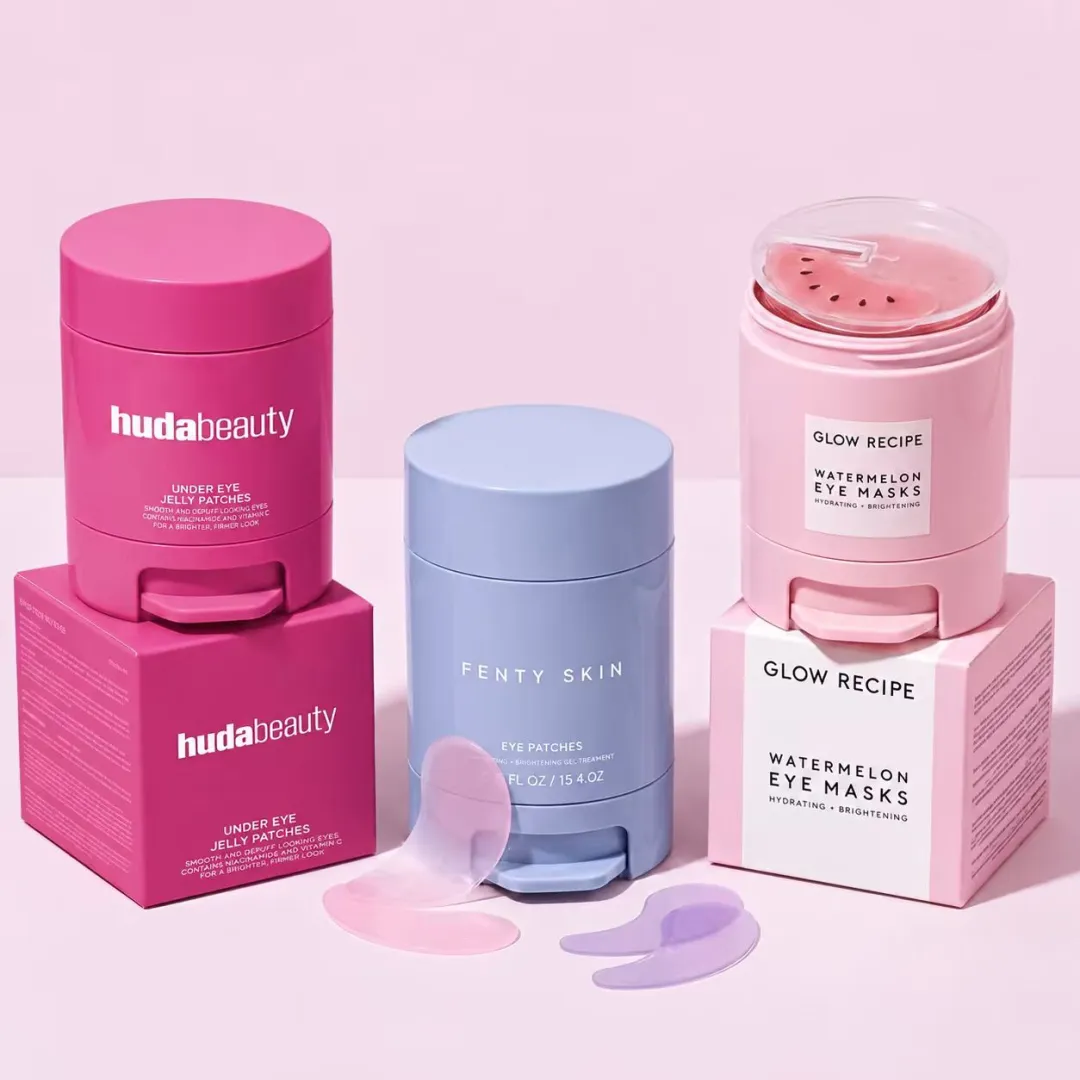
Recently, a rare new product collision appeared in the beauty circle.
Fenty Skin under Rihanna first previewed a freshly sliced hydrogel eye mask: the entire gel is stored in a jar, and by rotating the bottom device, one piece is cut on the spot each time.
Within a few days, Glow Recipe, which started with Korean skincare, and Huda Beauty, founded by beauty blogger Huda Kattan, also successively exposed similar new products.
The three products differ in color, formula, and brand positioning, but the most recognizable usage method is highly consistent: rotate, slice, and use immediately.
The three new products were released too close together, and the international internet quickly focused on "who copied whom."

The first to bring the new product to the forefront was Fenty Skin.
On 9 month 17 day, Fenty Skin previewed the new Hydrating Plump Fresh-Cut Hydrogel Eye Mask on its official Instagram, calling it a first of its kind. Common jarred eye masks have the eye mask sheets pre-stacked in the jar, but this product stores the entire hydrogel in an airtight container. The user rotates the bottle body, and the top device cuts out a piece on the spot.
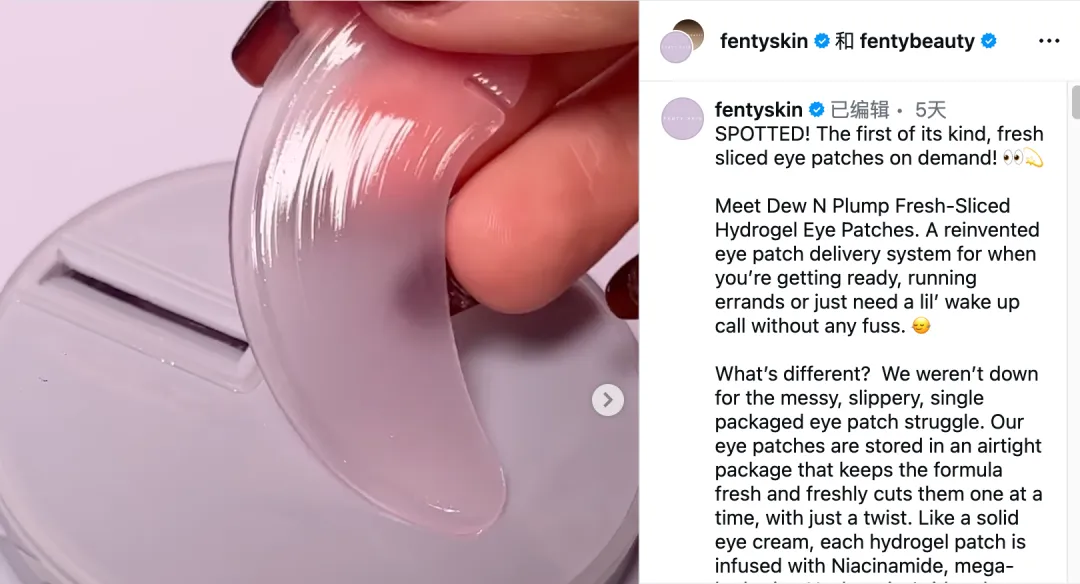
▍Image source: Fenty Skin official account
The product is currently in a soon-to-launch state, and the official website shows a price of 42 US dollars (approximately 300 yuan). The slicing structure immediately became the biggest selling point of this new product.
Five days later, a similar new product from Glow Recipe was exposed. On 9 month 22 day, beauty blogger The Lipstick Lesbians posted a video showing Glow Recipe's not-yet-on-sale fresh-slice eye mask: a whole hydrogel is stored in a jar, and by rotating the device, one piece is cut each time.
Almost on the same day, another beauty blogger exposed a new Huda Beauty eye mask product that had not yet been officially released. The usage shown in the video is very close to the previous two, also using a rotating slice structure.
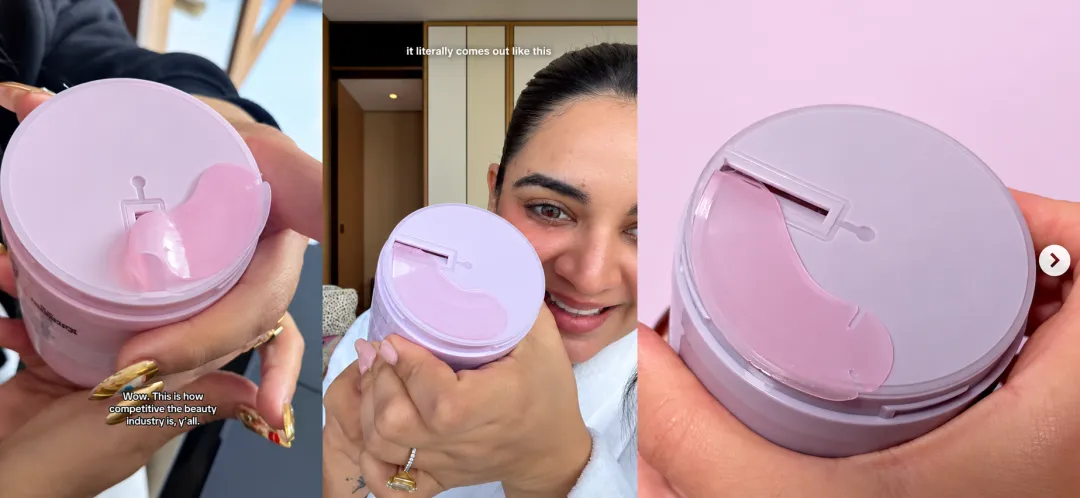
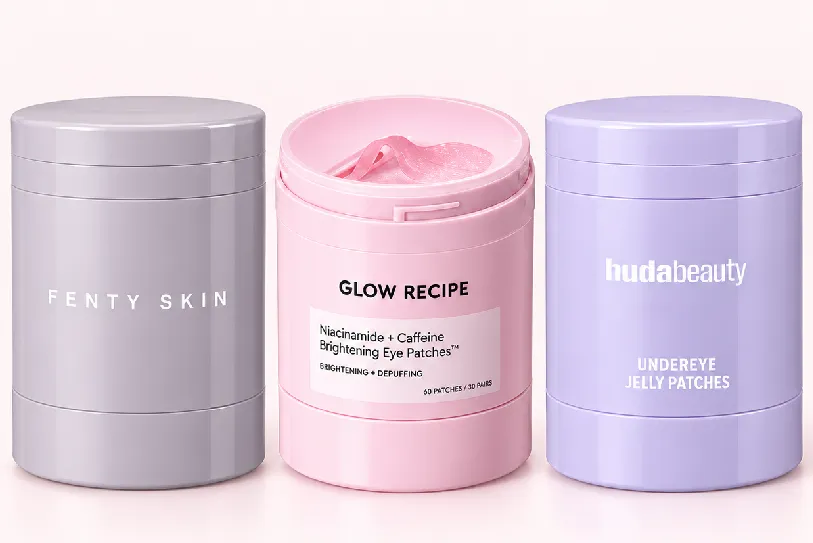
▍From left to right: Glow Recipe, Huda Beauty, Fenty Skin product images
Within just a few days, Fenty Skin, Glow Recipe, and Huda Beauty brought out products with highly overlapping core structures: whole hydrogel storage, rotating device, instant slicing, and single-piece use.
The international internet quickly focused on "who copied whom." But this inference is hard to establish.
First, from the development cycle perspective, mutual copying does not make sense.
Fenty Skin publicly released the new product on 9 month 17 day, and similar products from Glow Recipe and Huda Beauty were exposed around 9 month 22 day, with only 5 days in between. For a skincare new product involving special packaging structure, this time is not enough to complete the development process.
A beauty product that requires reformulation typically takes 12 to 18 months from concept to launch; even with a compressed schedule, it takes 4 to 9 months. Formula stability and compatibility testing with packaging alone usually requires about 3 months. Five days is not enough to complete the entire process from seeing a competitor's product, sourcing packaging, to formula adaptation, testing, and mass production.
When Fenty Skin first showed the fresh-cut eye mask to consumers, Glow Recipe and Huda Beauty's products were likely already in the late development stage. 9 month 22 day was just the time they surfaced together, not the time the three projects actually started.
Second, the formulas also do not match.
Glow Recipe puts exosomes and caffeine into the product narrative, Fenty Skin emphasizes niacinamide, hyaluronic acid, and fruit-derived ingredients, and Huda Beauty has not yet officially disclosed complete product information. The highly overlapping parts are mainly concentrated in the storage method of the hydrogel eye mask and the rotating slice structure.
If the three products had already entered development processes separately before being made public, then another question arises: why did three brands choose almost the same product form at such a close time?

The answer must be sought in the supply chain behind the brands.
This year, a replaceable grinding eye mask packaging from Korean cosmetics packaging company Samhwa won the Minister of Trade, Industry and Energy Award at the Korea Packaging Exhibition. In the official materials, this packaging already uses the concept of fresh cutting: the entire hydrogel is stored directly in a dedicated container, and when used, a single piece is cut out through a rotating structure, while the rest of the contents remain in the jar.
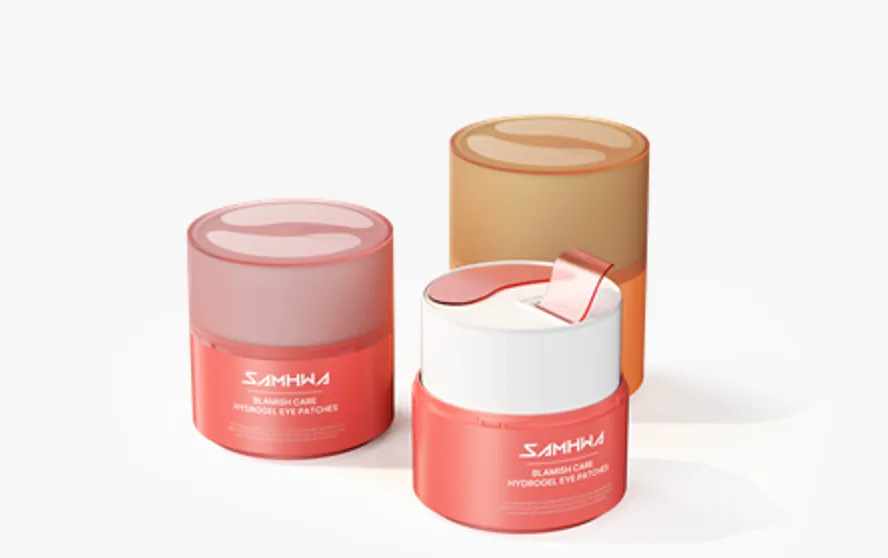
▍Image of the award-winning product from packaging supplier Samhwa
Structurally, it is already very close to the new products exposed this time by Fenty Skin, Glow Recipe, and Huda Beauty. The most recognizable designs of the three products—whole storage, rotation, and instant slicing—are already a complete solution at the upstream packaging end.
Making the packaging is only the first step; what really allows it to quickly enter multiple brands is the OEM/ODM end.
Cosmax's EOGM platform has publicly released a hydrogel collagen grinding eye mask solution: 30 pairs, 60 pieces, using grinding jar packaging, with partially customizable formula, a minimum order quantity of 5000 pieces, and a reference delivery period of 60 to 90 days after design confirmation.
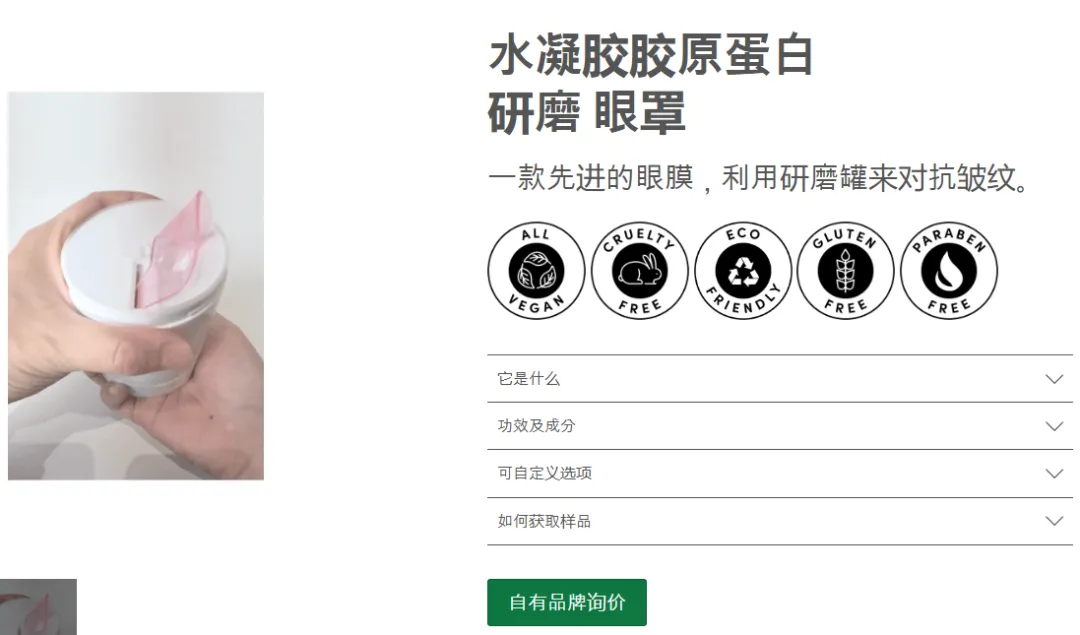
▍Cosmax EOGM hydrogel collagen grinding eye mask solution
If a brand wants to develop a similar product, it no longer needs to first find a packaging factory and then separately complete content development, packaging matching, and the entire product design. The OEM/ODM platform has already integrated the hydrogel content, grinding packaging, and subsequent customization into one solution, and brands can adjust the formula, packaging visuals, and product positioning on this basis.
The fresh-cut eye mask has thus transformed from a packaging idea into a product that can directly enter the brand development process.
Corresponding cases also quickly appeared on the consumer end. On 7 month 16 day, Korean brand Wonder Bath launched a slice essence, and the official introduction says to cut it off and apply it. Currently there are three versions: pores, lightening spots, and firming, with 60 pieces per jar. It is not an eye mask, but the product logic is consistent with the three new products this time: whole storage, cut when used.
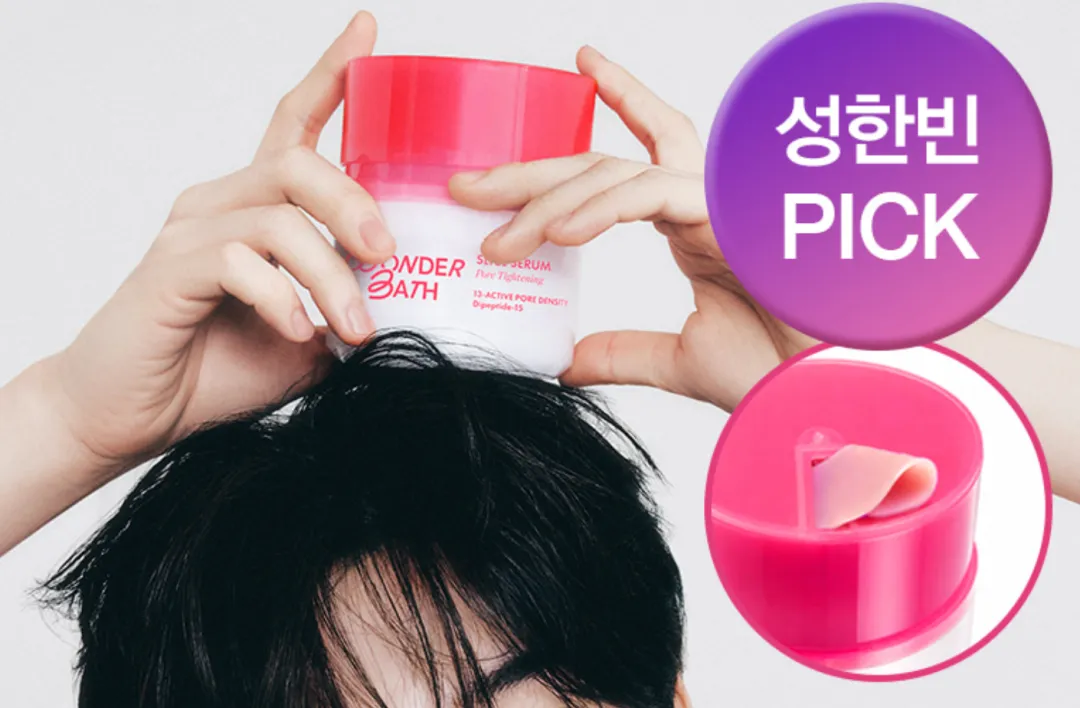
▍Wonder Bath product image
Two months later, Fenty Skin previewed the freshly cut hydrogel eye patches on 9 month 17 day, and within a few days, similar new products from Glow Recipe and Huda Beauty were exposed one after another.
Packaging material companies first created the rotating slicing structure, OEM platforms integrated it into customizable finished solutions, Korean brands were the first to bring it to market, and then similar products appeared concentrated among international brands. When a new packaging material and product form enters the OEM system and can be stably produced, customized, and delivered, it has the opportunity to enter the selection and development vision of multiple brands at the same time. Different brands each complete several months of development, and the launch nodes are concentrated in the same time window, which is not surprising.
Currently, there is no public information to prove that Fenty Skin, Glow Recipe, and Huda Beauty used the same packaging material from Samhwa, nor can it be confirmed whether the OEM for the three is Cosmax. This supply chain cannot yet be drawn as a direct supply relationship from Samhwa to Cosmax to the three major brands.
But what can be confirmed is that before the concentrated exposure of the three international brands, the freshly cut hydrogel had already completed commercialization in the Korean supply chain from packaging materials, OEM solutions to brand products. What the three encountered this time is precisely a round of supply chain innovation that has entered the diffusion period.

Pulling the perspective away from this eye patch, the development method of beauty new products itself is also changing.
In the past, brand product teams first proposed a relatively clear concept, and then separately sought raw material suppliers, OEM companies, and packaging material companies to complete development. Now, upstream companies are participating in product definition earlier and earlier. Raw material suppliers directly provide ingredient concepts and application directions, packaging material companies proactively develop new usage structures, and OEM companies combine formulas, dosage forms, packaging materials, and efficacy selling points into complete solutions, which are then handed to brands for selection and adjustment.
The starting point brands receive has changed from a blank sheet of paper to a set of semi-finished products that have already undergone partial validation.
This model is highly efficient. Mature formula bases, validated packaging structures, and ready-made production lines can save a lot of time from zero development. Some OEM companies even standardize minimum order quantities, delivery cycles, and customizable ranges, allowing small-volume brands to quickly obtain new products that previously required significant R&D resources.

▍Cosmax hydrogel product production site, image source: Cosmorning
The more mature the supply chain capability, the easier it is for different brands to see similar opportunities at the same time.
When a packaging material company develops a new structure, it will not face only one customer. When an OEM company launches a trend solution, it will also propose it to different brands simultaneously. If a certain product form happens to hit the consumer trend of the year, it may spread rapidly along the supply chain within a few months. Brands each adjust formulas, colors, efficacy, and visuals, and when they go to market, the appearance and usage may still be highly similar.
The freshly cut eye patches that appeared concentratedly from Fenty Skin, Glow Recipe, and Huda Beauty this time are a very intuitive sample of this development mechanism.
Brand product capabilities therefore face new tests. Obtaining a new packaging material, a popular ingredient, or an OEM solution is increasingly difficult to constitute a barrier alone. The parts that can truly create differentiation will continue to shift backward: whether exclusive cooperation can be obtained, whether standard solutions can be made into clearly different formulas and usage experiences, whether sufficiently solid efficacy evidence can be supplemented, and whether the brand has the ability to redefine a product possibility provided by the supply chain into its own product.
The supply chain is helping the beauty industry launch new products faster, while also compressing the lead time brought by form innovation.
When more and more brands develop new products based on similar technologies and product solutions, grabbing a new concept is only the first step. How to avoid ending up making the same face will increasingly test brand product capabilities.