
On a production line, should a powder cake be demolded first or freeze-dried first?
This seemingly insignificant process step became the key to a patent dispute between the world's largest beauty OEMCosmaxand Marie Dalgar's affiliated companyShanghai Zhenchun.
A Supreme People's Court judgment published on 10 month 9 day shows that Cosmax lost a patent invalidation lawsuit, and the invention patent "Method for Preparing Powder" of Shanghai Zhenchun Biotechnology Co., Ltd. remains valid.
The lawsuit originated from Cosmax's application to the China National Intellectual Property Administration to declare the patent invalid. After the application was not supported, Cosmax filed an administrative lawsuit against the CNIPA as the defendant, hoping to overturn the decision, but lost at first instance and was again rejected after appealing to the Supreme People's Court.
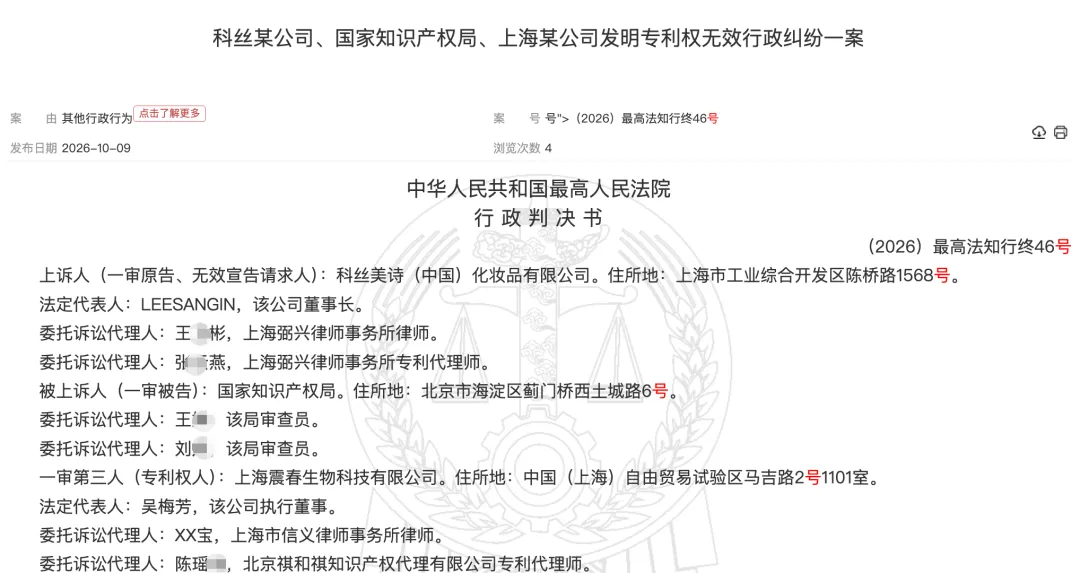
▍Image source: China Judgments Online
On the other hand, Shanghai Zhenchun also sued Cosmax and other companies in a separate patent infringement lawsuit. Around this patent, entities related to well-known beauty brands such as Fangli, Gouqi, and Perfect Diary have also been involved in disputes.
What Cosmax attempted to overturn was an invention patent "Method for Preparing Powder" applied for by Shanghai Zhenchun in 2019 and granted in 2022.
From a technical perspective, Shanghai Zhenchun's patent addresses a very practical production problem: how to make the powder easier to remove completely from the mold while maintaining the three-dimensional shape of the finished product and reducing breakage, deformation, and other issues.
Around this patent, Cosmax raised several disputes, the most critical of which wasthe timing of demolding。
To prove that Shanghai Zhenchun's technical solution lacked inventiveness, Cosmax submitted a Japanese patent document published in the 80s as prior art comparison evidence.
This Japanese patent also involves the use of freeze-drying technology to manufacture powder cosmetics, but there is a clear difference between the two technical solutions: the Japanese patent adopts a method of freeze-drying the powder together with the mold and then demolding after completion; Shanghai Zhenchun's patent requires first freezing and solidifying the powder in the mold, then demolding, and then freeze-drying the semi-finished product.
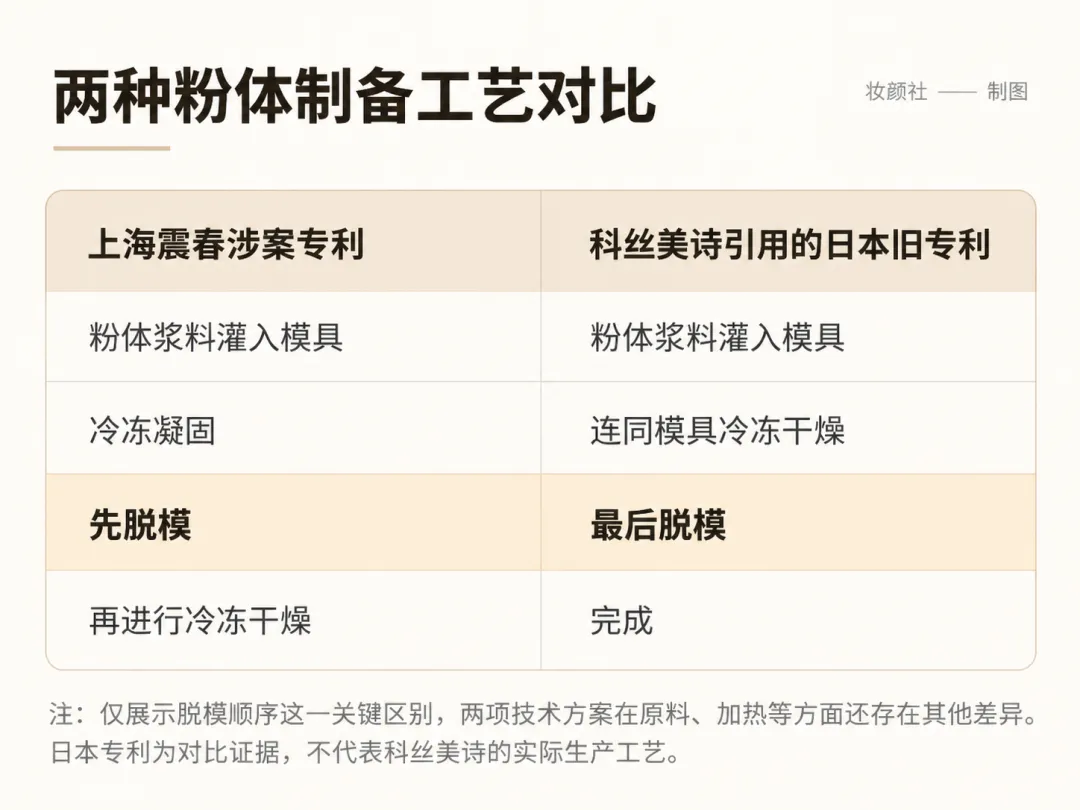
Cosmax believed that Shanghai Zhenchun's adjustment of the demolding sequence was merely a routine operation and did not constitute a real technical innovation.
In Cosmax's view, production personnel could choose when to demold the powder based on actual conditions. Even if Shanghai Zhenchun's process of demolding first and then freeze-drying could improve the yield rate, this effect was predictable and did not require inventive effort.
In addition, Cosmax also questioned that Shanghai Zhenchun's patent did not clearly specify the specific pre-cooling time, and some process parameters only provided numerical ranges, making it difficult to guarantee the expected effect under different conditions.
In other words, Cosmax not only believed that the process lacked innovation but also questioned whether it could achieve the claimed technical effect.
However, the Supreme People's Court did not accept Cosmax's above claims. In response to Cosmax's several challenges, the Supreme People's Court responded one by one.
1. Regarding whether the comparative experiment is reasonable.
The experimental report from Shanghai Institute of Technology submitted by Shanghai Zhenchun showed that under the same other experimental conditions, the process of first freezing and solidifying, demolding, and then freeze-drying adopted by its patent could achieve better demolding results. Cosmax questioned that the experiment did not use the original formula of the Japanese patent and was insufficient to prove that Shanghai Zhenchun's process was superior.
But the Supreme People's Court held that since the comparison was about the effect of demolding timing on the product, it was reasonable to use the same formula for the experiment. That is, it was not comparing which formula was better, but which demolding sequence was better under the same formula.
2. Regarding whether the demolding sequence is a conventional means.
Cosmax argued that early demolding was merely a routine operation that production personnel could choose based on actual conditions. But the Supreme People's Court held that Cosmax failed to prove that this demolding sequence was a conventional technical means in the industry, nor could it prove that the prior art could directly suggest this process arrangement.
3. Regarding the patent not limiting the pre-cooling time.
Cosmax questioned that Shanghai Zhenchun's patent did not clearly specify the specific pre-cooling time, making it difficult to guarantee the expected effect under different conditions. The Supreme People's Court held that technical personnel could reasonably determine the operation time based on material properties and solidification state, and it was not necessary to limit it in the patent.
Ultimately, the Supreme People's Court upheld the conclusion that Shanghai Zhenchun's patent at issue was valid.
On the other hand, outside the patent invalidation battle, Shanghai Zhenchun filed a patent infringement lawsuit against Cosmax. In 2025 year 7 month, Shanghai Zhenchun sued Cosmax, Aishengze (Shanghai) Biotechnology, and Shanghai Xiedian E-commerce for patent infringement.
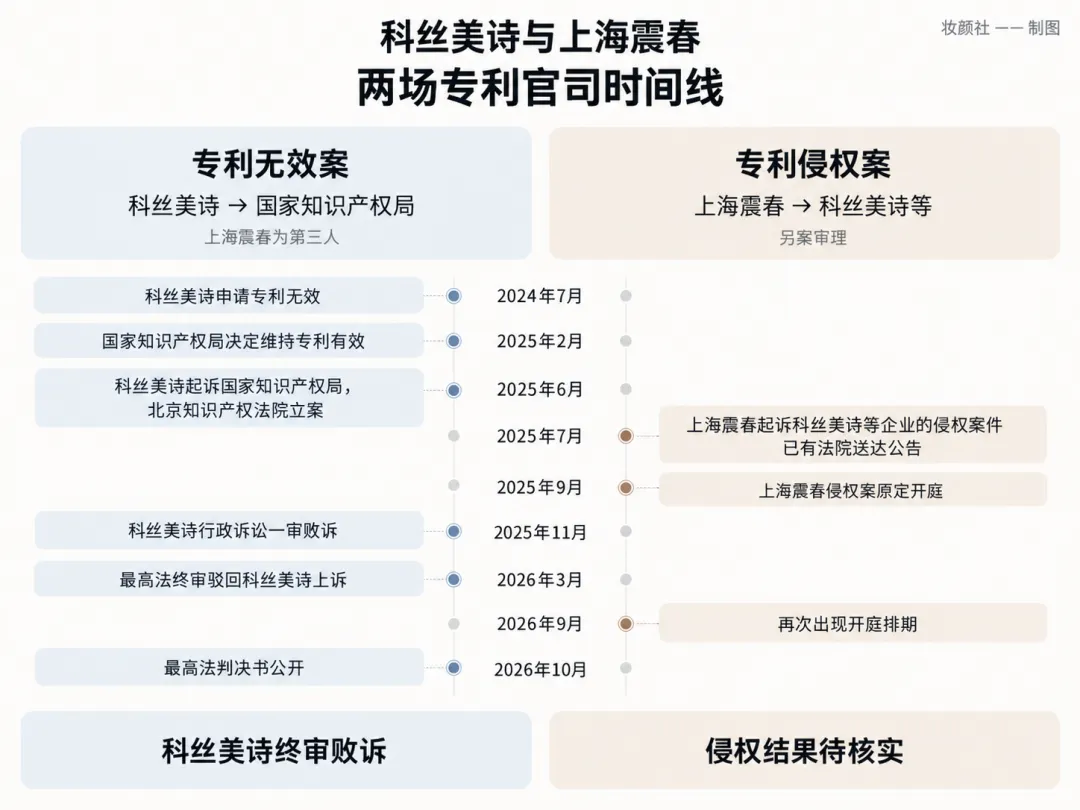
It is understood that this series of lawsuits revolves around the "Method for Preparing Powder" patent held by Shanghai Zhenchun, alleging that the relevant companies are suspected of infringing its invention patent rights.
However,the currently public case announcements have not disclosed which specific product Cosmax is involved with, nor have they stated which allegedly infringing production processes Shanghai Zhenchun accuses it of using. In 5 of this year, Cosmax responded in an interview that the case is still progressing and specific details are inconvenient to disclose.
In this dispute, the corporate background of Shanghai Zhenchun is also worth noting. Public business registration information shows that Shanghai Zhenchun is wholly owned by Jiachuang Investment Co., Ltd. And Shanghai Chuangyuan Cosmetics Co., Ltd., the company behind the domestic cosmetics brand Marie Dalgar, is also wholly owned by Hong Kong Jiachuang Investment Co., Ltd.In other words, Shanghai Zhenchun and Marie Dalgar belong to the same corporate group.
Shanghai Chuangyuan itself is a cosmetics R&D and OEM enterprise, with its own brand Marie Dalgar, and also provides OEM services for international beauty groups such as L'Oréal and Procter & Gamble. Public information from the Shanghai Fengxian District government shows that in 2024 5, Shanghai Chuangyuan's "three-dimensional precision carving technology new powder cosmetics" project received 60 ten thousand yuan in special science and technology funds from Fengxian District.
That is to say, the affiliated enterprises of Shanghai Zhenchun are themselves engaged in cosmetics production and technology R&D, and are in the same beauty manufacturing field as Cosmax.
And the enterprises involved in this series of lawsuits are far more than Cosmax. In 4 of this year, the relevant entities of cosmetics brands such as FANCL, Gouqi, and Perfect Diary, as well as OEM enterprises such as Shanghai Zhenchen and Shanghai Zhenxin, were also sued together by Shanghai Zhenchun.
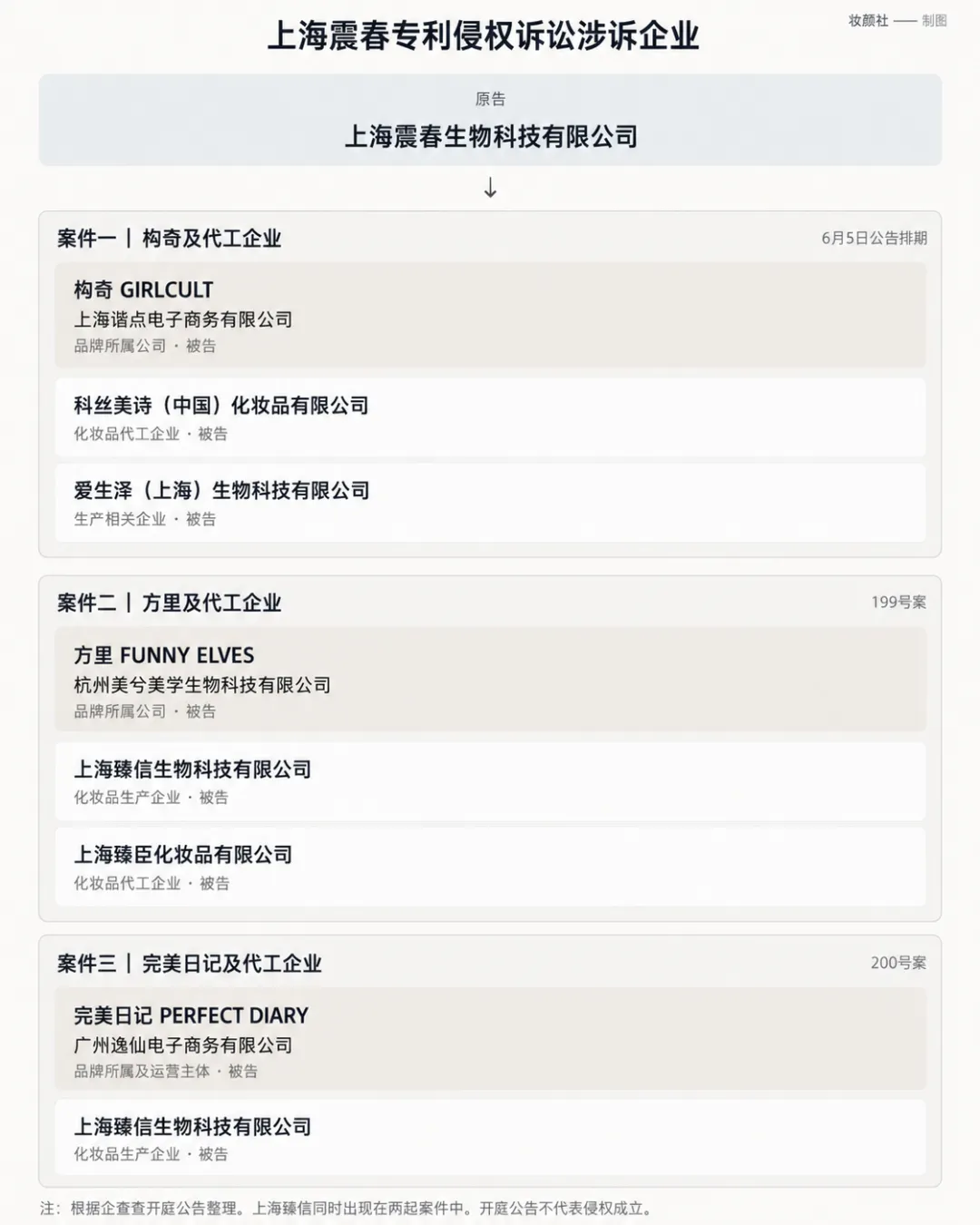
Among them, a public response from FANCL reveals the relationship between this lawsuit and the beauty supply chain.
FANCL stated that the freeze-dried powder raw material used in its involved product "Little White Cake" was purchased from Shanghai Zhenchen. FANCL believes that the relevant technical dispute mainly involves the production process of the raw material provided by the supplier, and the brand itself did not actively implement the relevant patented technology.
Further inquiry into patent information reveals that Shanghai Zhenchen itself also holds invention patents in the field of powder preparation. In 2024 10, Shanghai Zhenchen obtained an invention patent authorization titled "Preparation method of powder products, powder products and powder products".
The published embodiments of this patent also involve processes such as powder freezing, demolding, and freeze-drying, and its patent citation records include Shanghai Zhenchun's "powder preparation method" patent applied for in 2019.This means that when Shanghai Zhenchen applied for its own patent, it had already listed Zhenchun's patent as a cited document, indicating that it was aware of the existence of that patent.
However, the technical overlap between the two companies' patents does not necessarily mean that Shanghai Zhenchen's actual production process constitutes infringement.
From OEM factories such as Cosmax to downstream brands such as FANCL, Shanghai Zhenchun's series of lawsuits involve different stages of powder product R&D, production, and sales.
Why does a manufacturing process originally hidden in the production line cause multiple brands and OEM enterprises to face patent disputes at the same time?What lies behind this is the increasingly complex relationship between beauty products and manufacturing technology.
It is still unknown who will win or lose this round of patent infringement lawsuits. But regardless of the court's decision, a more thought-provoking question has already been raised:A beauty product is launched by a brand, but the core technology for manufacturing it may not be in the brand's own hands.
Today's beauty OEM factories are no longer just completing production according to brand requirements. Taking Cosmax as an example, its official website discloses that the company's services cover multiple stages including product R&D, formula design, packaging material development, and production manufacturing, with more than 300 R&D personnel in China alone. Under this cooperation model, the brand is responsible for product positioning and market sales, while the formula and manufacturing process may be developed by the OEM factory. A product from concept to market often requires different enterprises to complete together.

▍Cosmax R&D Laboratory
But there is an easily overlooked issue here:A brand spending money to develop a product does not mean it automatically owns all the technical patents involved in that product.
According to Article 859 of China's Civil Code, in a commissioned development relationship, if the parties have not agreed otherwise, the right to apply for a patent for an invention-creation belongs in principle to the research developer, and the commissioning party may legally exploit the patent.In the beauty industry, this means that when a brand commissions an OEM factory to develop a formula or process, if it is not clearly stipulated in the contract, the patent is likely to belong to the OEM factory, not the brand.
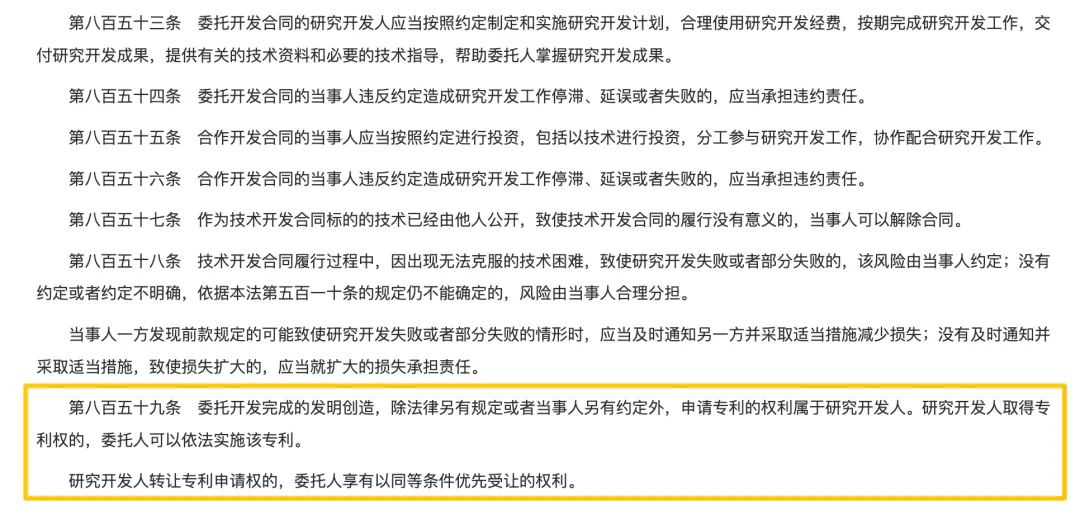
▍Article 859 of the Civil Code
And the patent dispute involving Shanghai Zhenchun this time also involves another layer of risk:An OEM factory having its own patent does not mean that the process it uses will not infringe others' patents.
Even if an OEM factory has its own powder preparation patent, it does not mean it can freely use all related processes. The relevant judicial interpretation of the Supreme People's Court clearly states that if the actually used technical solution falls within the protection scope of another's prior patent, it cannot be determined that there is no infringement solely because it has also obtained patent authorization.
In addition, the protection of a manufacturing method patent does not necessarily stop at the factory production stage. China's Patent Law stipulates that using a protected patented method without permission, as well as using or selling products directly obtained by that method, may involve patent infringement.
This means that even if a brand does not personally participate in production, it cannot simply assume that all intellectual property risks in the manufacturing stage are unrelated to itself.
More noteworthy is that many of the plaintiffs and defendants in this lawsuit are themselves OEM enterprises. Behind Zhenchun is Marie Dalgar's manufacturing system, while Cosmax, Zhenchen, and Zhenxin are OEM factories of different scales. Zhenchun's patent covers a set of freeze-dried powder processes, not a specific product.
This means that,as long as an OEM factory uses freeze-drying technology to produce powder compacts, it may fall within the protection scope of this patent.Zhenchen's patent citation records include Zhenchun's patent, and FANCL's "Little White Cake" is purchased from Zhenchen. This litigation chain precisely illustrates that a key process patent can be transmitted along the supply chain from OEM factories to downstream brands.
When OEM factories begin to use process patents to block each other, the focus of competition is no longer just production capacity, cost, and delivery time, butwhoever masters the patent for a key process gains greater bargaining power in the supply chain. Cosmax attempted to invalidate Zhenchun's patent through a declaration of invalidity, while Zhenchun turned the patent into a weapon through infringement litigation. Essentially, both are fighting for the same thing:the right to define the freeze-dried powder process。
In the past, when brands evaluated a contract manufacturer, they often focused on product quality, production costs, delivery cycles, and R&D capabilities. But this lawsuit reminds the industry that, in addition, it is necessary to clarify whether the technology used by the supplier involves patents of other companies, whether the brand has the legal right to use the relevant technology, and how the two parties should bear responsibility in the event of a dispute.
For contract manufacturers, manufacturing processes that can reduce production losses and improve yield rates not only have production value, but may also form a technical advantage through patents—but the premise is that the technology itself does not infringe on the prior patents of others.
Whether a beauty product can be made tests R&D and production capabilities; whether the technology used to make it can be used legally and continuously is another question that needs to be answered.