On 9 month 21 day, BRODA published a "Solemn Statement" on its official WeChat account, attaching a 44-page redacted judgment, announcing the final result of the sales agency contract dispute with its ten-year agent Shanghai Ruizhi Pharmaceutical Technology Co., Ltd. (hereinafter referred to as Ruizhi).
Ruizhi's appeal was dismissed. The Shanghai High People's Court upheld the first-instance judgment, confirming that Borunda's termination of the exclusive agency contract relationship on 2024 year 12 month 20 day was lawful.
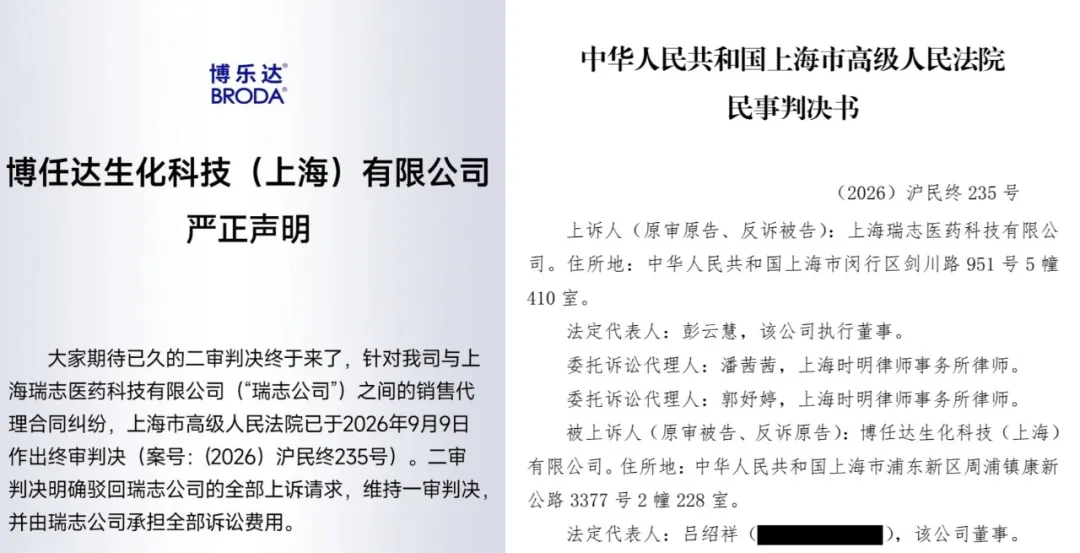
▍ Borunda's statement and (2026) Hu Min Zhong No. 235 civil judgment
This dispute attracted widespread attention in the beauty industry. The two parties cooperated for more than ten years. Ruizhi was long responsible for BRODA's market promotion, channel construction, and sales management. Borunda later also held 30% equity in Ruizhi. After the two parties broke up at the end of 2024, whether the termination was valid and who was responsible entered judicial proceedings.
Previously, the two parties had each presented their own arguments in public. This final judgment for the first time made clear determinations on some core disputes, and also gave this break between the brand and its ten-year agent a factual outline at the judicial level.

According to the final judgment, the cooperation between the two parties can be traced back to 2014 year.
In 2014 year 11 month, Ruizhi signed a "Sales Agency Contract" with Borunda, becoming the exclusive agent for BRODA professional line products in mainland China, responsible for sales and distributor management in professional line channels such as hospitals, beauty salons, and e-commerce platforms. The contract stipulated that Borunda shall not appoint other agents or distributors in Ruizhi's agency territory, and Ruizhi shall not deal in competing products of the same kind as BRODA.
In 2018 year 7 month, the relationship between the two parties deepened further. Borunda signed an "Equity Transfer Agreement" with Ruizhi and its two shareholders. Zhong Jinlu and Yu Lixin transferred 10% and 20% equity respectively. Borunda acquired 30% equity in Ruizhi for 1 yuan, and the two founders together held 70%.
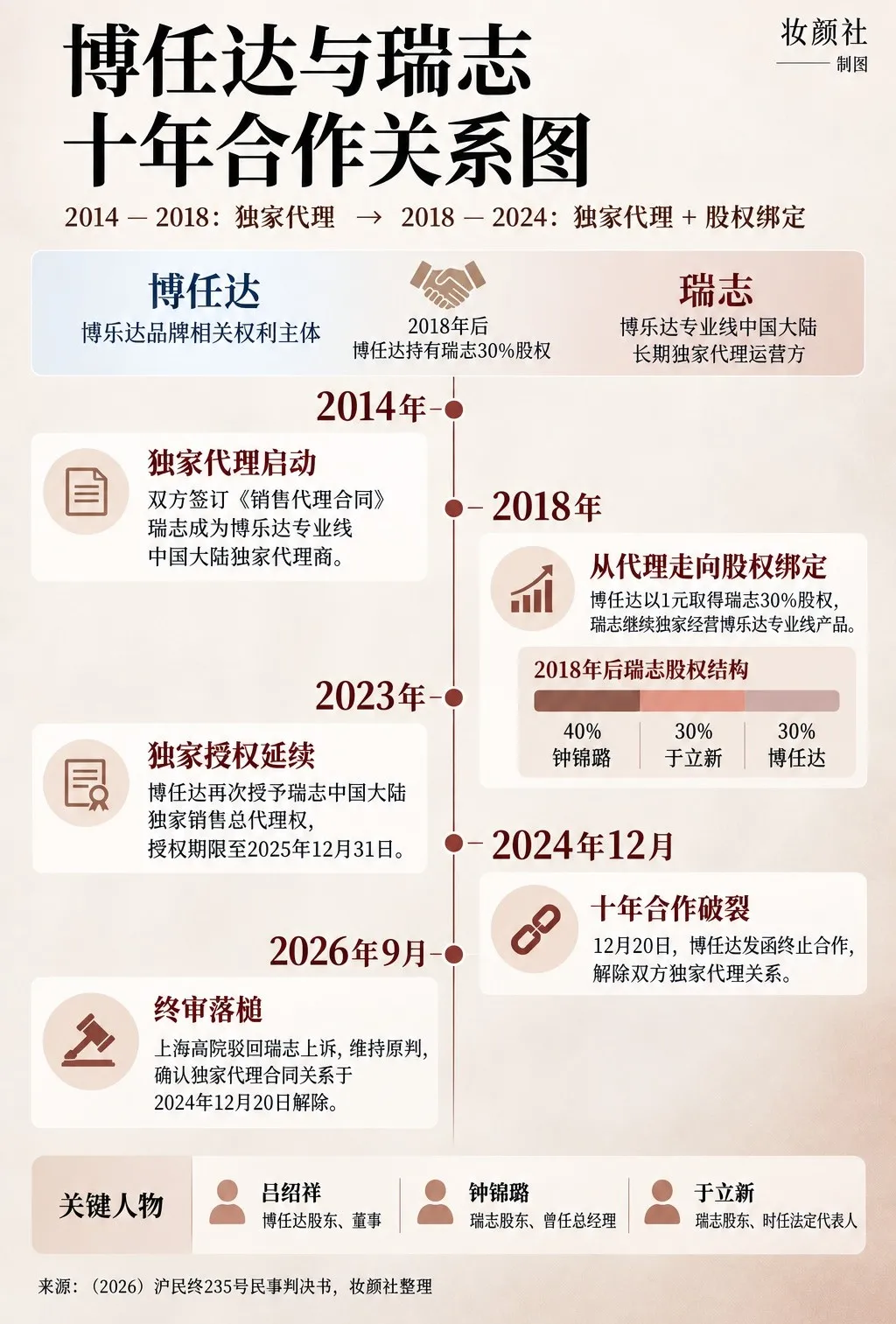
The "Framework Agreement" signed in the same period determined the subsequent cooperation model. Borunda ensured Ruizhi's exclusive operation and sales of BRODA professional line products and future new products through authorization. Borunda did not participate in Ruizhi's daily operations. Ruizhi was responsible for market promotion, channel construction, and sales management. In addition to product sales revenue, Borunda also shared company profits through holding 30% equity in Ruizhi. The relationship between the two parties had gone beyond the scope of brand and distributor.
In 2023 year 1 month, Borunda again issued a letter of authorization to Ruizhi, confirming it as the exclusive general sales agent for BRODA brand products in mainland China, with a term until 2025 year 12 month 31 day.
The Shanghai High Court found in its judgment that after the equity binding was added in 2018, the attributes of sharing benefits and risks between the two parties were significantly enhanced. Borunda focused on R&D and production, entrusting brand development to Ruizhi. This cooperation required a much higher basis of trust than an ordinary buyer-seller relationship.
Brand authorization, channel operation, and equity interests were all entangled. Once torn apart, the entire cooperation system would be affected.

The official seal issue that surfaced in the second half of 2024 year rapidly deteriorated this ten-year cooperation. The following facts and court findings are all from the final judgment.
1. Privately engraving and using the official seals of Borunda and suppliers.
In 2024 year 10 month, Lü Shaoxiang told Ruizhi's legal representative Yu Lixin in WeChat that a seal denied by the manufacturer had appeared in the market supervision department's investigation materials. Yu Lixin replied that after verification it was indeed privately engraved and then stamped, and the company had also found multiple self-engraved seals of Borunda, Sibei, Weiyuan, etc., and the relevant seals had been destroyed.
Two days later, Ruizhi and Yu Lixin issued a "Statement of Circumstances" to Borunda, admitting that Ruizhi had privately engraved and held relevant official seals for work convenience without prior notification to the relevant companies.
The first-instance court found on this basis that Ruizhi had privately engraved the official seals of Borunda and two suppliers. The Shanghai High Court upheld this finding in the second instance, and pointed out that this act was suspected of criminal offense, and also constituted civil infringement, violating the principle of good faith. The first-instance court's determination of fundamental breach was not improper.
2. Privately filing and producing "BRODA Hydra-Glow Elastic Single-Dose Essence".
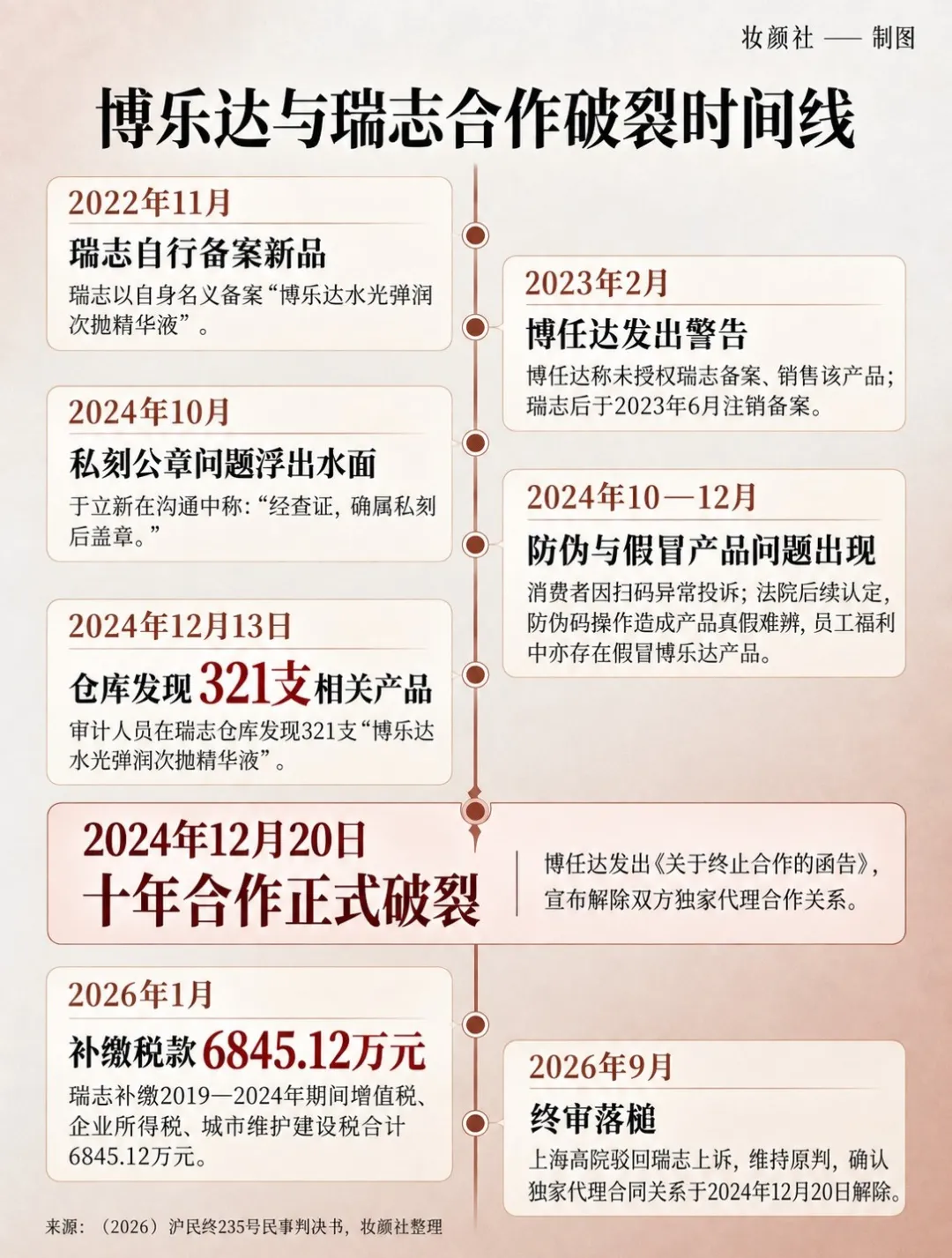
In 2022 year 11 month, Ruizhi filed this product in its own name. In 2023 year 2 month, Borunda discovered it and issued a warning letter, stating that it had not authorized Ruizhi to use the BRODA trademark to file and sell this product. Ruizhi then canceled the filing in 6 month of that year.
But in 2024 year 12 month, auditors found 321 units of this product in Ruizhi's warehouse. The outer packaging and individual products all bore the BRODA and BRODA trademarks, and the filer was Ruizhi.
The Shanghai High Court found on this basis that Ruizhi not only filed the product but also actually produced related products. After receiving the warning, Ruizhi only canceled the filing and did not destroy the products, and the breach continued until 2024 year 12 month.
3. Improper anti-counterfeiting code method; counterfeit goods appeared in employee benefits.
In 2024 year 10 month, a consumer failed to scan the code on the Tmall flagship store, suspected counterfeit goods, and complained. Borunda then conducted a spot check at Ruizhi's office and found counterfeit products.
The court found that Ruizhi adopted an anti-counterfeiting code method that was activated upon order placement, rather than showing authenticity after scanning. The Shanghai High Court held that this operation objectively made it difficult to distinguish genuine from fake products, causing a negative impact on the BRODA brand and Borunda's goodwill.
Counterfeit BRODA products appeared in Ruizhi's employee benefits, and the court also upheld the first-instance finding.
4. Owing taxes and failing to operate in compliance.
On 2026 year 1 month 13 day, Ruizhi paid back taxes including value-added tax, corporate income tax, and urban maintenance and construction tax for the period from 2019 to 2024, totaling 6845.12 ten thousand yuan. The court included tax arrears and non-compliant operation as factors in the breakdown of the trust basis.
On 2024 year 12 month 20 day, Borunda sent a "Letter on Termination of Cooperation" to Ruizhi, announcing the termination of the "Sales Agency Contract" and related cooperation agreements. Ruizhi believed Borunda had no right to unilaterally terminate the cooperation and demanded restoration of supply and authorization. The dispute then entered litigation.
Multiple breaches of contract accumulated, and the cooperation relationship that originally relied heavily on trust lost the basis for continuation.

It is worth mentioning that in the first instance, Ruizhi requested confirmation that Borunda's termination on 2024 year 12 month 20 day was invalid, continued performance of the relevant agreements, and claimed compensation exceeding 3 hundred million yuan. Of which about 1.69 hundred million yuan was for loss compensation, and about 1.40 hundred million yuan was for 2024 annual sales and purchase price difference compensation.
The court of first instance dismissed all of Ruizhi's main claims and supported Borenda's counterclaim. The court confirmed that the exclusive agency contract relationship formed by the parties based on the 2014 Sales Agency Contract and the 2018 Equity Transfer Agreement and Framework Agreement was terminated on 2024 12 20.
Ruizhi refused to accept the ruling and filed an appeal. The Shanghai High Court upheld the original judgment in the second instance, and all of Ruizhi's appeal requests were dismissed.
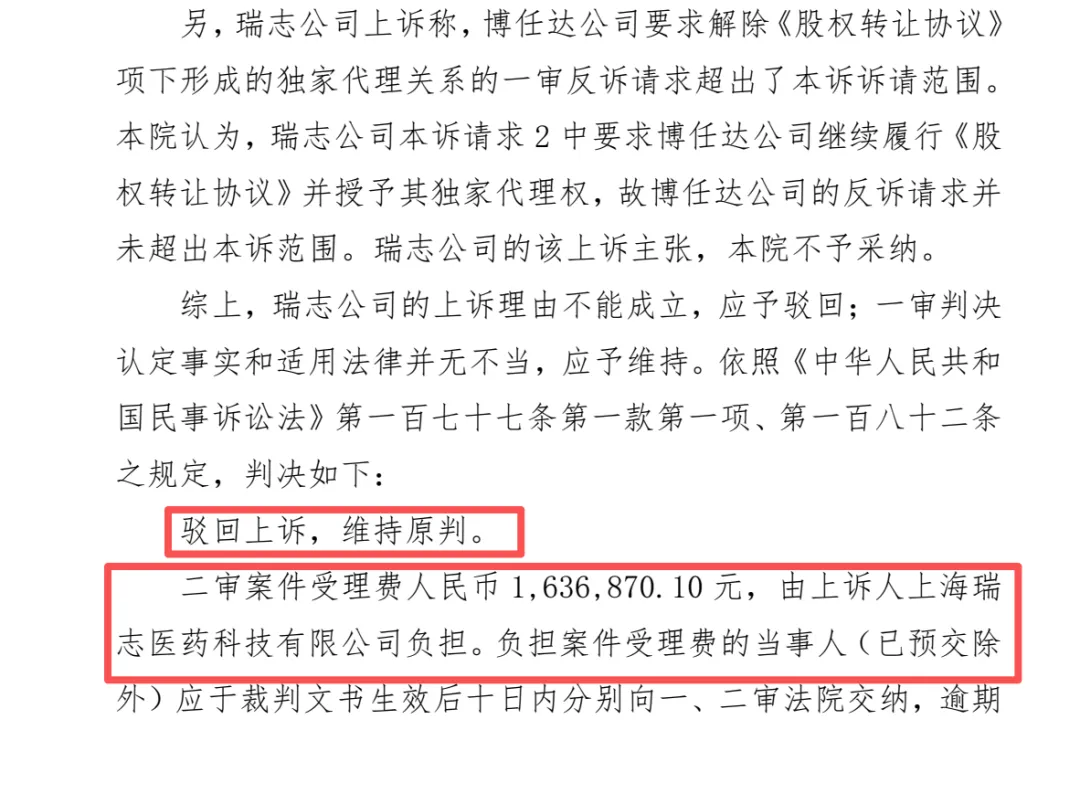
▍Screenshot from the judgment document
However, not all of Borenda's accusations were supported by the court.
The court found four breaches by Ruizhi: privately engraving the official seal, filing and selling related products without authorization, anti-counterfeiting code operations, and counterfeit products in employee benefits. However, other breach allegations raised by Borenda in the termination letter and counterclaim were deemed insufficiently evidenced by the court and were not confirmed.
In addition, Borenda submitted in the second instance a letter from the insurance company terminating the insurance contract, attempting to prove that Ruizhi had committed insurance fraud. However, the Shanghai High Court held that this evidence was unrelated to the substantive dispute in this case and did not admit it.
However, the judgment left another unresolved relationship—equity.
The court dealt with the exclusive agency contract relationship in this case. The 30% equity in Ruizhi held by Borenda was not within the scope of this judgment. The court held that the equity issue belongs to another legal relationship, and if there is a dispute, the relevant parties may resolve it separately.
YAN BEAUTY REVIEW's inquiry found that the two parties still have multiple lawsuits in progress. The second-instance case of the company surplus distribution dispute between Borenda and Ruizhi and others was heard on 9 8; another second-instance case of the company resolution validity confirmation dispute between the two parties was also heard in 8. In addition, Ruizhi also sued Borenda for a sales contract dispute.
The significance of this dispute is no longer just about Bole Da changing its agent. Over ten years, the two parties moved from exclusive agency to equity binding, with brand research and development, channel operation, market promotion, and shareholder interests intertwined in the same cooperative relationship. Once the binding is deep enough and trust breaks down, termination is no longer just about stopping supply, but quickly extends to equity, profit distribution, and corporate governance.
For the industry, this ongoing dispute leaves a more practical question: when a brand relies heavily on agents to complete market operations, and even further forms a community of interests through equity, how to delineate the boundaries between brand rights, management rights, and corporate governance is more important than how large a contract can be signed at the beginning of cooperation.