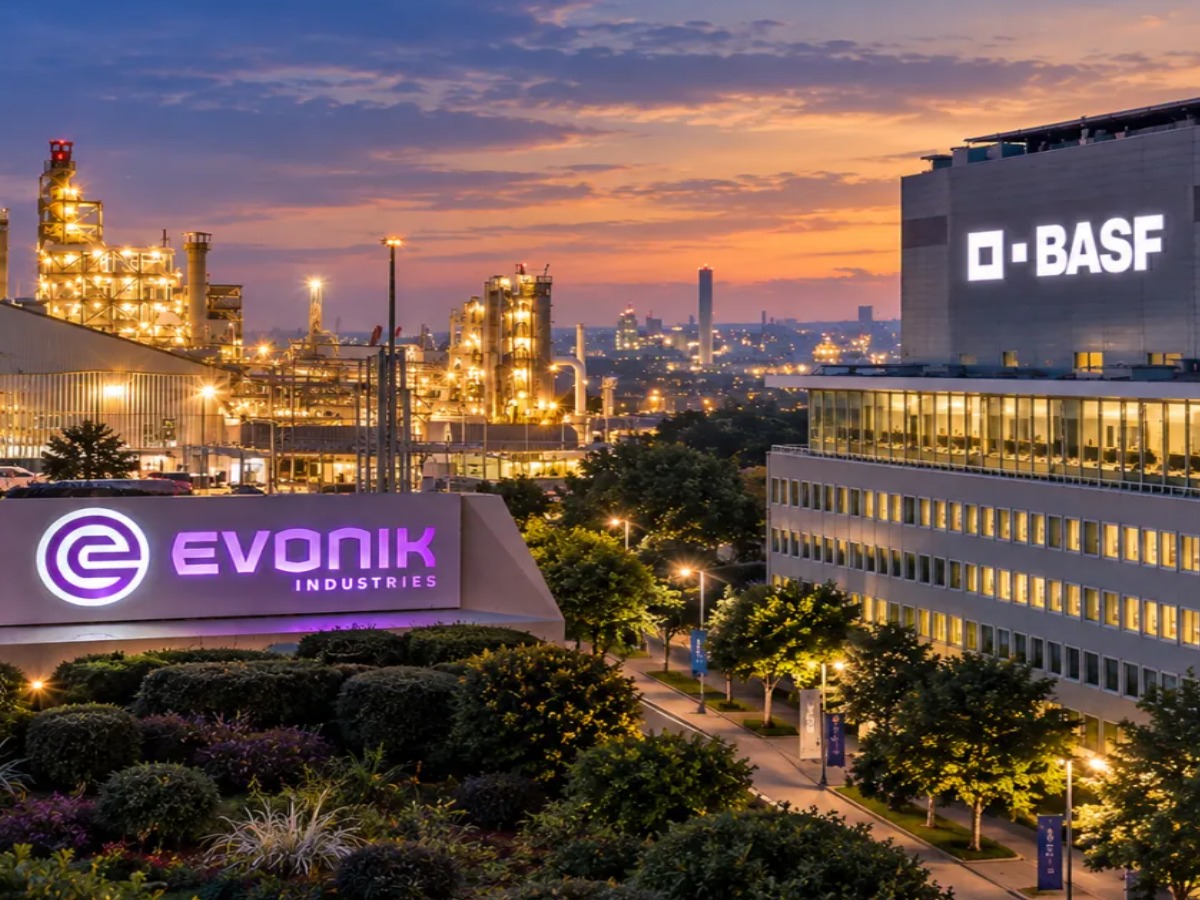
The global chemical industry may see a major merger and acquisition.
On 9 month 25 day,German chemical giant BASF confirmed that it is in exploratory contact with Evonik and its largest shareholder RAG-Stiftung regarding a potential acquisition. Evonik subsequently disclosed that BASF had sent a non-binding approach involving a possible voluntary public takeover offer for all Evonik shares. As of now, the two parties have not entered formal negotiations.
Both companies are important raw material suppliers in the global beauty industry chain. BASF's personal care ingredients business covers surfactants, emulsifiers, emollients, UV filters, and other categories; Evonik has deep layouts in ceramides, actives, biotechnology, and delivery systems.
Why is BASF eyeing Evonik now? If this deal moves forward, how will the beauty ingredients supply landscape change?

According to information disclosed by Evonik on 9 month 25 day, BASF made a non-binding approach involving a possible voluntary public takeover offer for all Evonik shares. BASF subsequently confirmed that it has separately initiated exploratory contact with Evonik and its largest shareholder RAG-Stiftung.
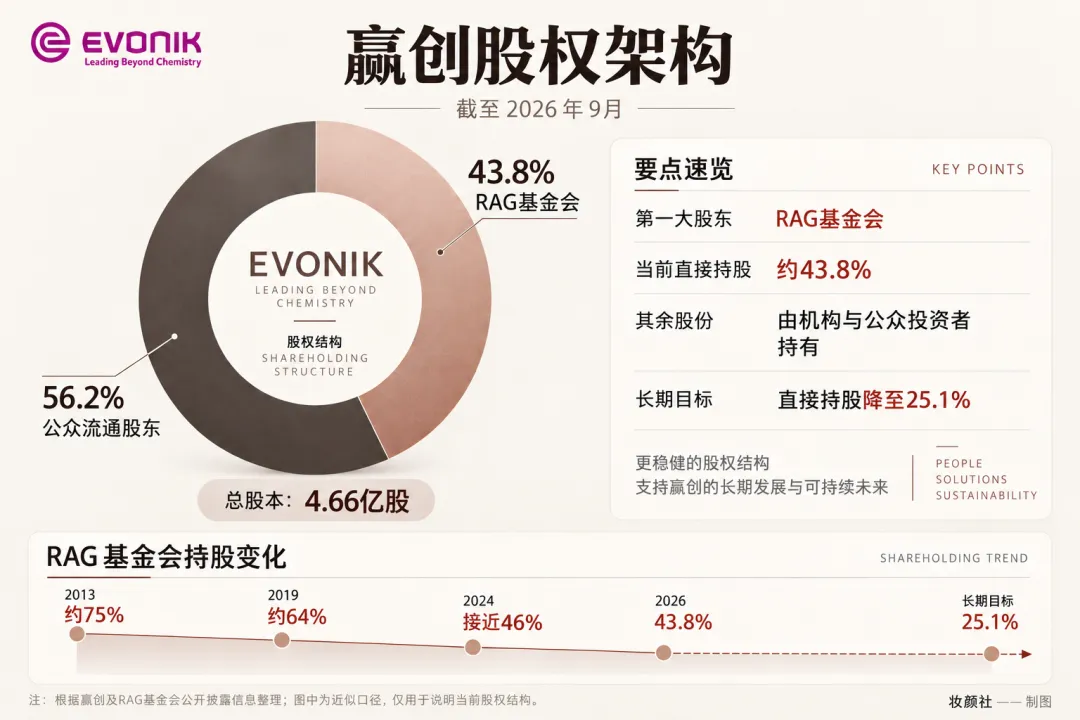
RAG-Stiftung's attitude is key to whether this deal can proceed. Currently, RAG-Stiftung holds 43.8% of Evonik's shares and is the company's largest shareholder. BASF's simultaneous communication with it also means that the subsequent progress of the transaction largely depends on the attitude of this core shareholder.
However, the transaction is still at a very early stage. The two parties have not entered formal negotiations, and BASF has not announced a price, transaction terms, or a specific timetable.
Before the news was announced, Evonik's market value was about 84 hundred million euros (about 640 hundred million yuan); after the news came out, its stock price rose by about 11% at one point, and its market value rose to about 92 hundred million euros (about 700 hundred million yuan). The capital market has begun to trade on the expectation of this acquisition, but whether BASF will ultimately make a formal offer remains uncertain.
This deal comes as Evonik is in the midst of the largest restructuring in its history. On 9 month 22 day, Evonik had just announced a new round of strategic adjustments, planning to further cut costs from 2027 to 2029, reduce about 3200 positions globally, and continue to advance the sale of some businesses. The company's management also bluntly stated that the European chemical industry is facing a "structural and economic crisis."
BASF is also readjusting its business portfolio. In 5 month of this year, the company launched the CoreShift program, focusing the next phase on four core businesses: chemicals, materials, industrial solutions, and nutrition and care, and clearly stated that it will continue to look for acquisition opportunities that can strengthen core businesses and drive profitable growth.
The strategic adjustments of the two companies thus have an intersection:Evonik is cutting costs and selling assets, while BASF, after completing a round of business sorting, is beginning to look for new growth assets.
Against this backdrop, what exactly does Evonik have that BASF wants?

In terms of size, BASF is far larger than Evonik. In 2025, BASF achieved sales of 596.57 hundred million euros (about 4561 hundred million yuan), while Evonik's sales in the same period were 141 hundred million euros (about 1078 hundred million yuan), a difference of more than four times.
In terms of business structure, the overall overlap between the two companies is limited, but personal care ingredients are one of the more obvious intersections.
In the beauty ingredients field, BASF is strong in scale and product coverage. In 2025, its care chemicals business sales reached 47.65 hundred million euros (about 364 hundred million yuan). Looking at personal care alone, BASF already covers actives, emollients, emulsifiers, polymers, surfactants, UV filters, and other categories, and has a global production and R&D network.
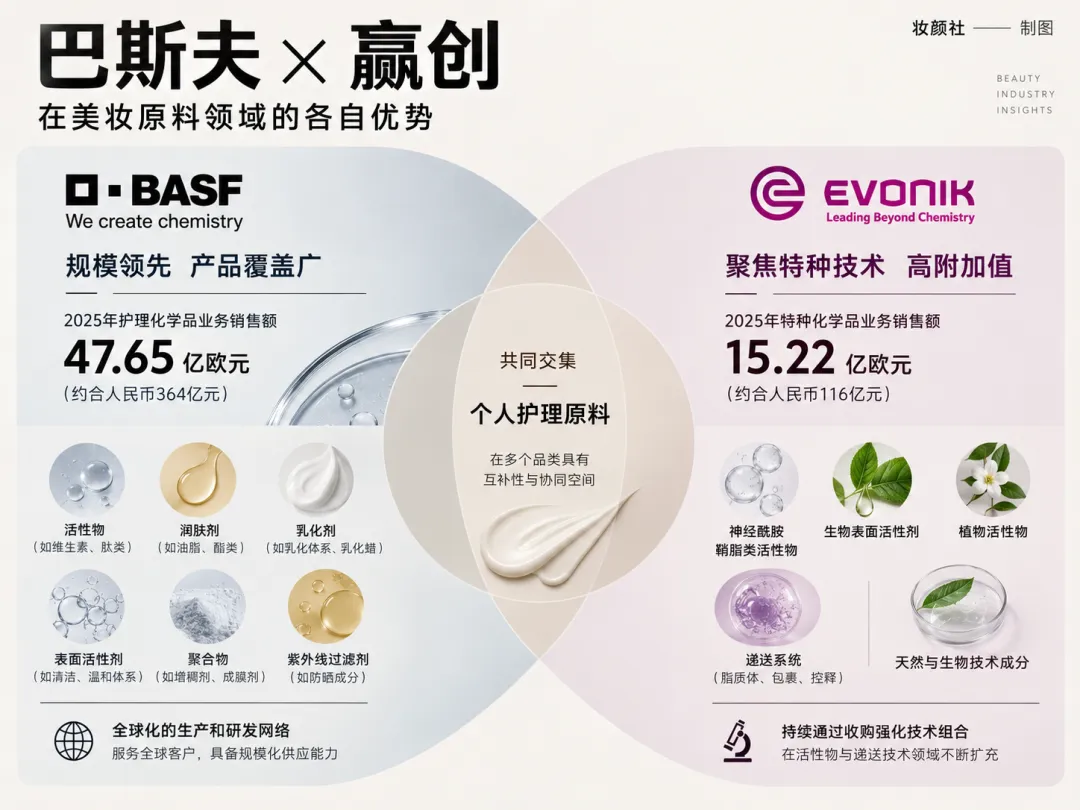
Evonik's advantages are more concentrated inhigh-value-added specialty technologies. From ceramides and sphingolipid actives to biosurfactants, plant actives, and delivery systems, Evonik has been expanding this part of its business in recent years. In 2021, the company acquired cosmetic delivery technologies such as liposomes, encapsulation, and controlled release, and since then has expanded its natural and biotechnology actives portfolio through multiple acquisitions.
In the past two years, Evonik's investment in high-value-added beauty ingredients has further extended to China. In 3 month of this year, Evonik chose to globally launch a "new sphingolipid ingredient" at the China International Cosmetics Personal and Home Care Ingredients Exhibition held in Hangzhou.
In 6 month, Evonik opened its first Beauty Science and Innovation Center in Asia in Shanghai, bringing biotechnology ingredient R&D, formulation development, efficacy testing, and consumer research onto the same platform. China is becoming an important market for Evonik's next-generation beauty ingredient R&D and commercialization.
From the perspective of beauty business, the complementary relationship between the two companies is already quite clear. BASF has a larger system of basic ingredients, production scale, and global supply network, while Evonik can add specialty technologies such as ceramides, biosurfactants, actives, and delivery systems.
If the deal ultimately lands,BASF's beauty ingredients capabilities will further extend to high-value-added actives, delivery technologies, and system solutions. Of course, Evonik's assets span multiple chemical fields, and businesses such as plastic additives and specialty polymers also have synergy potential, but BASF has not yet announced the specific acquisition logic.
But for the beauty industry, a more direct question is already on the table: if two leading raw material suppliers truly enter the same system, what will happen to the global beauty ingredients market?

Putting BASF and Evonik back into the global beauty ingredients market makes the weight of this deal more intuitive.
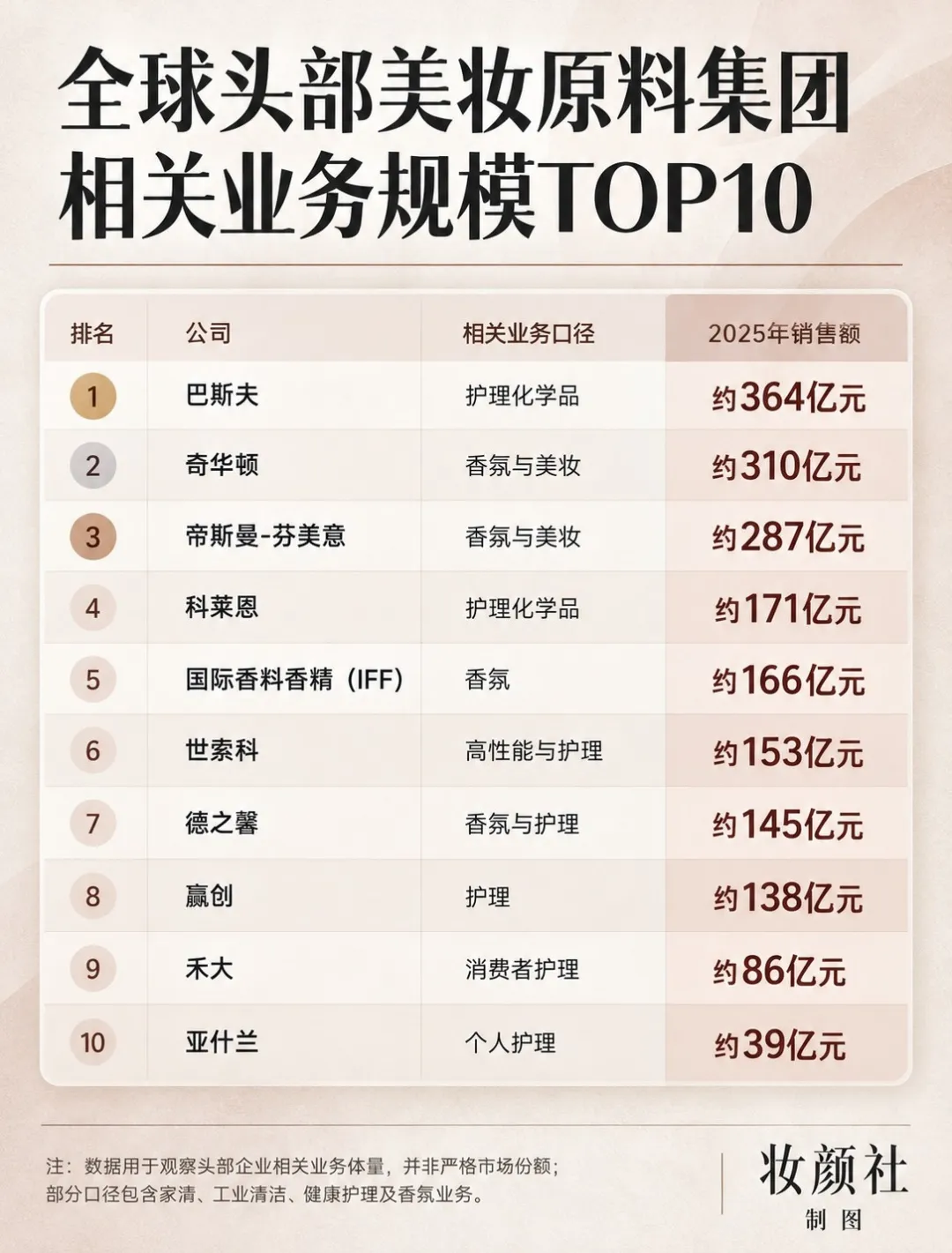
The list reflects a characteristic:the leading companies in the global beauty upstream come from different tracks。
Givaudan, DSM-Firmenich, International Flavors & Fragrances, and Symrise have large fragrance and flavor businesses; BASF, Clariant, Syensqo, and Evonik cover more personal care ingredients such as surfactants, emulsifiers, emollients, and actives; companies like Croda and Ashland have their own advantages in specialty functional ingredients and formulation technologies.
If BASF acquires Evonik, the most direct change will first occur in the scale of the leading companies.
Based on a rough addition of currently public relevant business scopes, the combined relevant business scale of BASF and Evonik in 2025 will reach approximately 502 hundred million yuan. In comparison, Givaudan is about 310 hundred million yuan, and DSM-Firmenich is about 287 hundred million yuan. BASF already ranks first, and after adding Evonik, the scale gap with other leading companies will further widen.
At the same time, Evonik, ranked eighth, will no longer participate in global competition as an independent supplier. The customer, R&D, production, and technical resources originally dispersed between the two companies will have the opportunity to be integrated into the same system.
There is another layer worth noting in this set of data. A large part of the business of leading companies such as Givaudan and DSM-Firmenich comes from flavors and fragrances, while the combination of BASF and Evonik is more concentrated in care chemicals, functional ingredients, and specialty technologies.
Once the transaction is completed, a large platform with a scale exceeding 500 hundred million yuan and centered on comprehensive care ingredients will emerge among the world's leading raw material suppliers. For companies such as Clariant, Syensqo, Croda, and Ashland, they will face a competitor that is larger in scale and broader in business coverage.
The asset adjustment in the upstream of global beauty has actually already begun. Clariant has been continuously expanding its cosmetic active ingredients business in recent years, and Syensqo has also initiated a strategic evaluation of its high-performance and care businesses this year. More and more international chemical groups are re-deciding which beauty and care assets are worth continued investment and which businesses need to be sold or integrated.
If the BASF-Evonik transaction continues to advance, it is likely to become one of the most iconic events in this round of global beauty upstream restructuring. The next thing worth observing is whether other international raw material giants will accelerate acquisitions, integration, or business adjustments accordingly.